

Introduction
For centuries, human health has been viewed primarily through the lens of physical, mental, and emotional well-being. Modern medicine has achieved remarkable success in diagnosing and treating diseases, while wellness practices have expanded to include nutrition, exercise, stress management, and mindfulness. Yet, despite these advancements, many individuals continue to experience unexplained fatigue, reduced vitality, difficulty concentrating, sleep disturbances, and a general sense of imbalance.
Could there be a missing dimension in our understanding of wellness?
The concept of Energy Hygiene seeks to address this question by introducing a systematic approach to recognizing, assessing, and managing the energetic influences that surround and interact with human beings every day.
Just as personal hygiene protects the body from physical contaminants, Energy Hygiene aims to help individuals maintain a healthy energetic environment that supports overall well-being.
The need for a new wellness paradigm
In the modern world, people are exposed to an unprecedented range of environmental influences:
- Rapid technological expansion
- Continuous electromagnetic exposure
- Urban living environments
- High levels of stress
- Increasing time spent indoors
- Reduced connection with natural environments
While many of these influences are considered part of modern life, there is growing interest in understanding how environmental factors may affect human vitality, performance, and quality of life.
Traditional wellness models focus primarily on:
- Physical health
- Mental health
- Emotional health
- Social health
Energy Hygiene proposes an additional dimension:
Energetic health
This dimension considers the interaction between the individual and the energetic characteristics of their environment.
What is Energy Hygiene?
Energy Hygiene may be defined as:
“The systematic identification, assessment, management, and optimization of environmental and personal energetic influences to support human wellness, vitality, and harmonious functioning.”
It is a preventive and wellness-oriented framework that seeks to identify potential energetic stressors and promote practices that enhance energetic balance.
Energy Hygiene does not replace medical care. Instead, it complements existing wellness approaches by focusing on an often-overlooked aspect of the human experience—the energetic relationship between people and their surroundings.
Understanding the concept through an analogy
Most people practice:
Physical hygiene
Examples include:
- Bathing
- Hand washing
- Dental care
- Clean living spaces
These practices reduce physical contamination and support health.
Similarly, Energy Hygiene proposes that individuals can benefit from maintaining an energetically supportive environment.
Examples may include:
- Assessing living spaces
- Reducing energetic stressors
- Enhancing environmental harmony
- Supporting personal energetic balance
Just as we cannot always see physical microbes with the naked eye, many energetic influences may not be immediately apparent.
The goal of Energy Hygiene is to make these influences more visible and manageable.
The core premise of Energy Hygiene
The Energy Hygiene Framework® is based on a simple principle:
Human wellness is influenced not only by what happens inside the body, but also by the energetic quality of the environment surrounding the individual.
This perspective encourages a broader examination of factors that may affect:
- Vitality
- Comfort
- Productivity
- Sleep quality
- Mental clarity
- Emotional balance
- Overall well-being
The Energy Hygiene Framework®
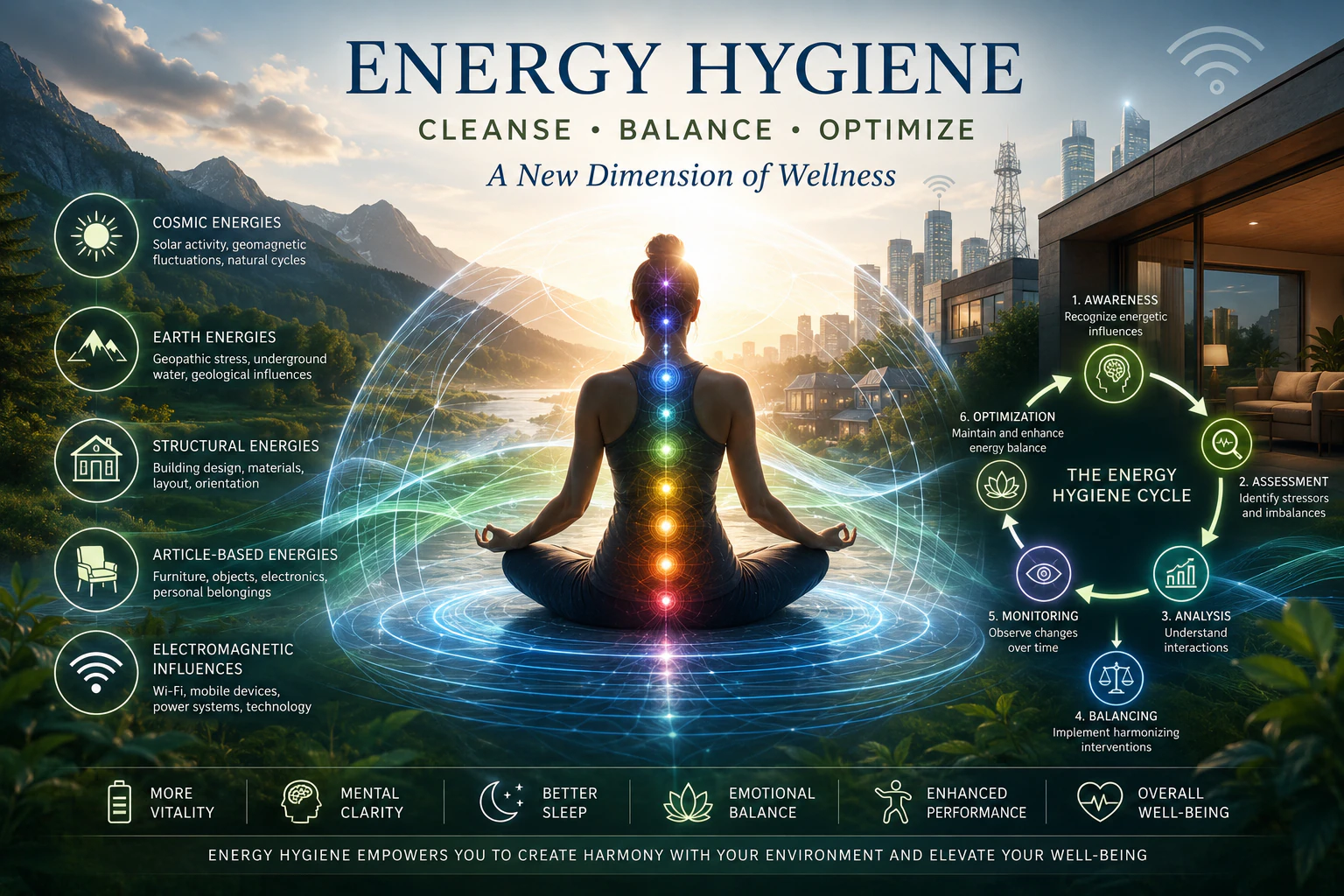
The Energy Hygiene Framework® recognizes several categories of energetic influences.
1. Cosmic energies
These refer to broader environmental influences associated with natural cycles and cosmic phenomena.
Examples may include:
- Solar activity
- Geomagnetic fluctuations
- Seasonal energetic changes
2. Earth energies
These involve energetic characteristics associated with the earth and specific geographical locations.
Examples include:
- Geopathic stress concepts
- Underground water streams
- Geological formations
- Land-based energetic variations
3. Structural energies
The design and construction of buildings may influence environmental quality.
Factors may include:
- Building layout
- Construction materials
- Room orientation
- Spatial organization
4. Article-based energies
Objects, materials, and personal belongings may contribute to the energetic characteristics of a space.
Examples include:
- Furniture
- Antiques
- Electronic devices
- Decorative objects
5. Electromagnetic influences
Modern lifestyles involve continuous interaction with technology.
Examples include:
- Mobile phones
- Wi-Fi systems
- Computers
- Communication infrastructure
The Energy Hygiene Framework® examines how these influences may interact with human well-being.
Why Energy Hygiene matters
People often maintain healthy diets and regular exercise routines yet still experience persistent challenges such as:
- Low energy
- Reduced concentration
- Poor sleep quality
- Unexplained discomfort
- Difficulty recovering from stress
Energy Hygiene encourages a broader investigation of environmental factors that may contribute to these experiences.
By evaluating energetic influences, individuals may gain additional insights into optimizing their living and working environments.
The Energy Hygiene Cycle
The Energy Hygiene Framework® follows a continuous cycle:
Step 1: Awareness
Recognizing that energetic influences may exist.
Step 2: Assessment
Identifying potential energetic stressors and imbalances.
Step 3: Analysis
Understanding possible interactions between the individual and the environment.
Step 4: Balancing
Implementing corrective or harmonizing interventions.
Step 5: Monitoring
Observing changes over time.
Step 6: Optimization
Maintaining an energetically supportive environment.
This ongoing process forms the foundation of Energy Hygiene practice.
Energy Hygiene and human performance
Beyond wellness, Energy Hygiene may have applications in:
Homes
Creating supportive living environments.
Workplaces
Enhancing focus and productivity.
Educational institutions
Supporting learning environments.
Healthcare settings
Promoting holistic wellness approaches.
Hospitality and tourism
Designing energy-conscious spaces for guests.
Emerging technologies and Energy Hygiene
Advances in technology are creating new opportunities for exploring energetic wellness.
Areas of interest include:
- Biofield research
- Environmental monitoring systems
- Frequency-based assessment tools
- Aura assessment technologies
- Energy mapping methodologies
- Data-driven wellness frameworks
These developments may contribute to a more systematic understanding of energetic influences in the future.
Energy Hygiene as preventive wellness
A key strength of the Energy Hygiene Framework® is its preventive focus.
Rather than waiting for problems to develop, Energy Hygiene encourages individuals to:
- Evaluate their environment proactively
- Identify potential energetic stressors
- Maintain supportive surroundings
- Adopt energy-conscious lifestyle practices
This preventive approach aligns closely with modern wellness philosophies that emphasize optimization rather than merely disease management.
The future of human wellness
As wellness science continues to evolve, there is growing recognition that health is multidimensional.
The future of wellness may integrate:
- Physical health
- Mental health
- Emotional health
- Social health
- Environmental health
- Energetic health
Energy Hygiene represents an emerging framework that seeks to bring these dimensions together into a more comprehensive model of human well-being.
Conclusion
Energy Hygiene introduces a new perspective on wellness—one that recognizes the potential importance of energetic interactions between individuals and their environments.
By promoting awareness, assessment, balancing, and optimization of energetic influences, Energy Hygiene offers a structured approach to enhancing vitality and well-being in an increasingly complex world.
Just as personal hygiene became an essential part of public health in the twentieth century, Energy Hygiene may emerge as an important component of holistic wellness in the twenty-first century.
This article was migrated from the Foundation’s blog. Legacy address: https://www.energyhygienex.com/post/what-is-energy-hygiene-a-new-paradigm-for-human-wellness — earlier links continue to reach this article.