

Introduction
For more than a century, physical hygiene has been one of humanity’s greatest public health achievements. Practices such as hand washing, sanitation, clean drinking water, waste management, and personal cleanliness have dramatically reduced disease and improved quality of life worldwide.
Today, most people understand the importance of maintaining physical hygiene. We wash our hands, clean our homes, purify our water, and take precautions against physical contaminants. Yet, despite living in cleaner environments than ever before, many individuals continue to experience persistent fatigue, poor sleep, stress, lack of focus, emotional exhaustion, and a growing sense of imbalance. This raises an important question: have we mastered physical hygiene while overlooking other dimensions of human well-being?
The 21st century presents challenges that extend beyond physical contamination. We now live in an increasingly complex environment characterized by technological saturation, continuous connectivity, environmental stressors, and unprecedented energetic influences. As a result, a broader approach to wellness may be necessary. This is where the concept of Energy Hygiene emerges as an important complement to traditional physical hygiene.
The success story of physical hygiene
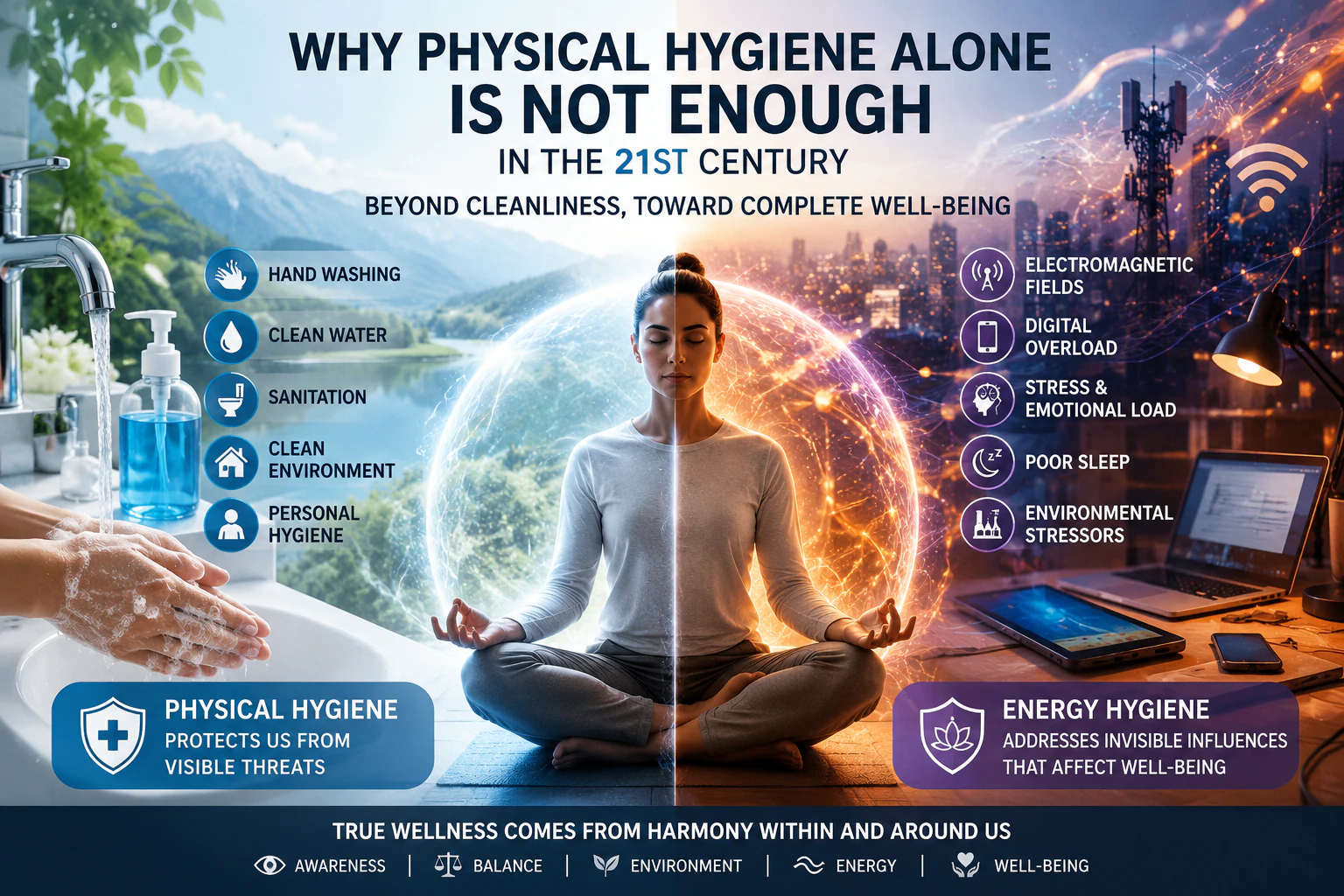
The importance of physical hygiene cannot be overstated. Historically, infectious diseases spread rapidly through contaminated water, poor sanitation, and inadequate personal hygiene. Public health initiatives transformed societies by introducing clean water systems, sewage treatment, personal hygiene education, food safety regulations, and hospital sanitation practices. These measures dramatically reduced mortality and increased life expectancy. Physical hygiene protects us from visible and measurable threats to health. However, the world has changed.
A different world than our ancestors knew
Humans evolved in natural environments with relatively limited exposure to artificial influences. Today’s world is fundamentally different. Modern individuals are surrounded by mobile phones, wireless networks, smart devices, artificial lighting, dense urban structures, continuous digital communication, and high levels of occupational stress. In many cases, people spend more than 90% of their time indoors, several hours daily in front of screens, and most waking hours connected to technology. While these developments have improved convenience and productivity, they have also created new environmental conditions that previous generations never experienced.
The hidden burden of modern living
Many people maintain excellent physical hygiene yet report experiencing persistent tiredness, sleep disturbances, mental fatigue, reduced concentration, emotional exhaustion, burnout, and reduced resilience to stress. Traditional wellness approaches often focus on diet, exercise, and medical evaluation — essential components of health. However, they may not always explain why some individuals continue to feel unwell despite maintaining healthy lifestyles. This has led researchers, wellness practitioners, and environmental health experts to explore broader influences on human well-being.
Beyond physical health: the emerging dimensions of wellness
Modern wellness science increasingly recognizes that health is multidimensional. Well-being is influenced by physical factors (nutrition, exercise, sleep, medical care), mental factors (thought patterns, cognition, psychological resilience), emotional factors (relationships, emotional regulation, life satisfaction), social factors (community, belonging, social support), and environmental factors (air quality, noise, lighting, living conditions). Increasingly, attention is also being directed toward energetic factors — the interaction between individuals and the energetic characteristics of their environment. This emerging perspective forms the foundation of Energy Hygiene.
The limits of physical hygiene
Physical hygiene focuses primarily on removing physical contaminants: germs are addressed by hand washing, dust by cleaning, contaminated water by filtration, waste by sanitation. These interventions address tangible physical hazards. However, physical hygiene alone does not evaluate environmental energetic influences, electromagnetic exposure patterns, geopathic stress concepts, structural energy characteristics, frequency-related environmental factors, or personal energetic balance. As our understanding of wellness evolves, it becomes clear that maintaining a healthy environment may require more than physical cleanliness.
The concept of Energy Hygiene
Energy Hygiene extends the principles of preventive care into the energetic domain. Just as physical hygiene seeks to remove physical stressors, Energy Hygiene seeks to identify and manage energetic stressors that may influence human well-being. The Energy Hygiene Framework® focuses on awareness, assessment, analysis, balancing, monitoring, and optimization. The objective is not to replace conventional health practices but to complement them by examining additional environmental influences.
The new environmental reality
The average person now interacts with multiple energetic environments every day: electromagnetic environments (mobile phones, Wi-Fi networks, smart devices, wireless communication systems), structural environments (homes, offices, commercial buildings, educational institutions), natural environmental influences (geological formations, land characteristics, natural electromagnetic phenomena), and personal environments (daily stress, emotional interactions, lifestyle patterns). Energy Hygiene encourages individuals to understand how these various influences may interact with overall wellness.
A useful analogy
Imagine living in a beautifully clean house. The floors are spotless. The kitchen is sanitized. The drinking water is pure. Yet the building suffers from poor ventilation, constant noise pollution, inadequate lighting, and high stress levels. Despite excellent cleanliness, occupants may still feel uncomfortable and unhealthy. Similarly, physical cleanliness alone may not address every factor influencing human well-being. Energy Hygiene proposes that the quality of the energetic environment may also deserve attention.
The evolution of preventive wellness
Public health evolved through several major stages: disease treatment (treat illness after symptoms appear), physical hygiene (prevent disease through cleanliness and sanitation), lifestyle wellness (promote healthy behaviors), environmental health (recognize the impact of surroundings), and Energy Hygiene (evaluate and optimize energetic influences within the human environment). This progression represents an expansion rather than a replacement of previous health models.
The future of wellness
The future of wellness is likely to be integrative. Tomorrow’s wellness models may combine medicine, nutrition, exercise, mental health, environmental science, energy assessment, and preventive energy balancing. As awareness grows, Energy Hygiene may become as familiar and essential as physical hygiene is today. The goal is simple: to create environments that support human vitality, resilience, performance, and well-being at every level.
Conclusion
Physical hygiene remains one of humanity’s greatest achievements and will always be fundamental to health. However, the challenges of the 21st century extend beyond physical cleanliness alone. Modern life exposes individuals to complex environmental influences that previous generations never encountered. As a result, wellness may require a broader perspective — one that includes not only physical, mental, and emotional factors but also the energetic characteristics of our surroundings. Energy Hygiene represents this next step in preventive wellness. The question is no longer whether physical hygiene is important. The question is: what additional dimensions of wellness must we understand to thrive in the 21st century?
This article was migrated from the Foundation’s blog. Legacy address: https://www.energyhygienex.com/post/why-physical-hygiene-alone-is-not-enough-in-the-21st-century — earlier links continue to reach this article.