

Introduction
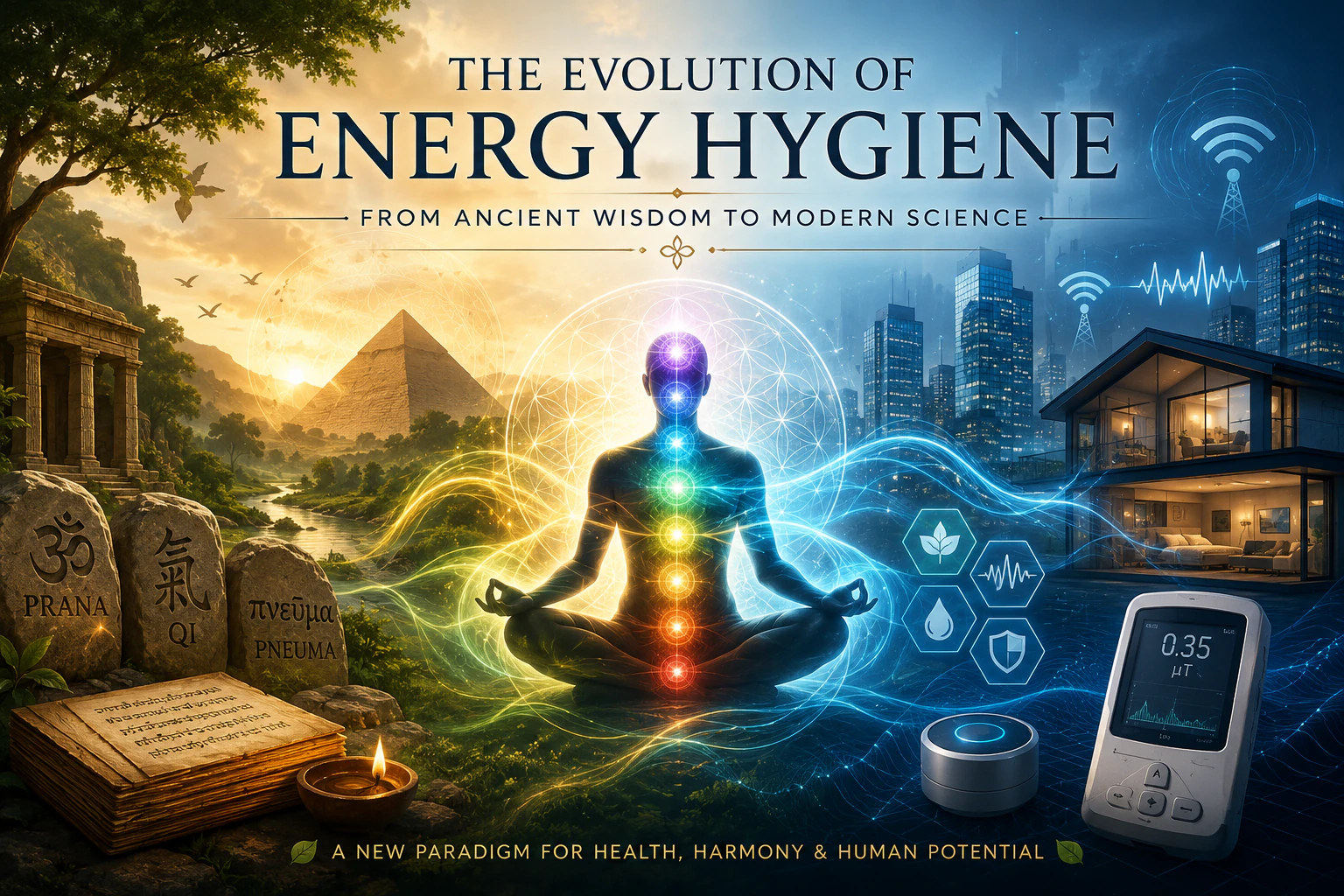
Throughout history, human beings have sought to understand the forces that influence health, vitality, and well-being. Long before the advent of modern medicine, ancient civilizations believed that life was sustained by an invisible vital force that connected the individual to nature, the environment, and the cosmos. Different cultures gave this life force different names: Prana in the Vedic traditions of India, Qi (Chi) in Traditional Chinese Medicine, Ka in Ancient Egypt, Pneuma in Ancient Greece, Ruach in Hebrew traditions, and Mana in Polynesian cultures. Despite differences in language and culture, a common theme emerged: human well-being was believed to depend upon harmony between the individual and the energies of the surrounding environment.
Today, advances in environmental science, biofield research, frequency-based technologies, and systems thinking are creating new opportunities to revisit these ancient concepts through modern investigative frameworks. The emerging discipline of Energy Hygiene seeks to integrate ancient wisdom with contemporary scientific inquiry, offering a structured approach to understanding and optimizing the energetic influences that may affect human wellness.
Humanity’s earliest understanding of energy
Long before microscopes, laboratory instruments, and medical imaging technologies existed, ancient societies carefully observed the relationship between people and their environments. They recognized that certain places felt revitalizing, certain locations seemed draining, natural environments often promoted well-being, and human vitality appeared connected to environmental conditions. These observations gave rise to systems of knowledge that emphasized balance, harmony, and energetic flow. Although these traditions were expressed through spiritual and philosophical language, they represented early attempts to understand the subtle interactions between humans and their surroundings.
The Vedic concept of Prana
Among the oldest recorded energy concepts is Prana, described in the ancient Vedic texts of India. Prana was understood as the universal life force that permeates all existence. According to Vedic philosophy: Prana flows through living beings; health depends upon balanced pranic flow; environmental conditions influence vitality; and human consciousness interacts with energetic forces. Practices such as yoga, pranayama, meditation, and Ayurvedic lifestyle disciplines were developed to maintain energetic harmony. These concepts continue to influence wellness practices around the world today.
Traditional Chinese Medicine and Qi
Traditional Chinese Medicine (TCM) introduced the concept of Qi, often translated as vital energy. According to TCM: Qi circulates through specific pathways; balanced flow supports health; blockages may contribute to dysfunction; and environmental conditions affect energetic balance. Techniques such as acupuncture, acupressure, Tai Chi, and Qigong were developed to support the harmonious movement of Qi. The emphasis on prevention and balance closely parallels the principles underlying modern Energy Hygiene.
Sacred spaces and environmental harmony
Ancient civilizations paid careful attention to the energetic qualities of physical environments. Vastu Shastra (India) focused on building orientation, spatial organization, environmental harmony, and human well-being. Feng Shui (China) examined the flow of environmental energy, architectural design, placement of objects, and landscape influences. Many ancient temples, pyramids, and ceremonial structures were intentionally aligned with solar cycles, lunar cycles, geographical features, and astronomical events. These traditions reflected a belief that environmental energies could influence human experience.
The rise of modern science
The scientific revolution transformed humanity’s understanding of the physical world. Major discoveries included gravity, electricity, magnetism, electromagnetic fields, atomic structure, and quantum phenomena. Many forces once considered invisible or mysterious became measurable and scientifically understood. Importantly, science demonstrated that invisible phenomena can profoundly influence daily life — radio waves, magnetic fields, X-rays, microwaves, and wireless communication signals all exist beyond normal human perception yet have measurable effects. This realization opened new avenues for exploring interactions between organisms and their environments.
The emergence of environmental health science
During the twentieth century, researchers increasingly recognized that health is influenced by environmental factors: air quality, water quality, noise pollution, chemical exposure, occupational hazards, and building environments. This gave rise to the field of environmental health. A key lesson emerged: the environment matters. The places where people live, work, and sleep can significantly influence their well-being. Energy Hygiene extends this environmental perspective into the energetic domain.
Biofield science and human energy research
In recent decades, scientists have begun exploring concepts often described under the term biofield. Biofield research investigates biological electromagnetic activity, physiological signaling systems, human-environment interactions, and energy-based therapeutic approaches. Research institutions around the world are examining how measurable biological fields may contribute to health and wellness. Although many questions remain unanswered, biofield science represents an important bridge between traditional energy concepts and modern scientific inquiry.
The technological age and new challenges
The 21st century has introduced environmental conditions unlike anything experienced by previous generations. Modern individuals are continuously exposed to wireless technologies, mobile communication systems, smart devices, artificial electromagnetic environments, and digital connectivity. At the same time, people spend increasing amounts of time indoors, often in highly engineered environments. These changes have prompted growing interest in understanding how environmental influences affect human performance, resilience, and quality of life.
From environmental health to Energy Hygiene
As knowledge evolves, wellness models continue to expand. The progression can be viewed as follows: the ancient era (recognition of vital forces and environmental harmony), classical healing systems (development of structured energy-based wellness practices), the scientific era (measurement of previously invisible physical forces), the environmental health era (recognition of environmental influences on health), and the Energy Hygiene era (systematic evaluation and optimization of energetic influences affecting human wellness). Energy Hygiene builds upon each of these stages rather than replacing them.
What makes Energy Hygiene different?
While many traditional systems focus on healing practices, Energy Hygiene emphasizes awareness (recognizing energetic influences), assessment (identifying potential energetic stressors), analysis (understanding environmental interactions), balancing (implementing corrective measures), monitoring (tracking changes over time), and optimization (maintaining supportive energetic environments). This structured framework transforms energy awareness into a practical wellness methodology.
Integrating ancient wisdom and modern technology
One of the defining characteristics of Energy Hygiene is its integrative approach. It respects the observations of ancient traditions while embracing modern tools and methodologies. Potential areas of integration include environmental assessment, frequency analysis, biofield research, electromagnetic studies, wellness monitoring systems, aura assessment technologies, and data-driven energy mapping. By combining historical insight with contemporary investigation, Energy Hygiene seeks to create a more comprehensive understanding of human wellness.
The future of Energy Hygiene
The future of Energy Hygiene may involve standardized assessment protocols, evidence-based research frameworks, environmental energy mapping, smart wellness technologies, personalized energy optimization systems, and integration with preventive healthcare. As scientific understanding continues to evolve, new opportunities may emerge to explore the relationship between humans and their energetic environments. The goal is not merely to treat illness but to optimize vitality, resilience, and quality of life.
Conclusion
The story of Energy Hygiene is part of a much larger human journey. From the ancient concept of Prana to modern biofield research, humanity has consistently sought to understand the invisible influences that shape health and well-being. Ancient civilizations recognized the importance of harmony between people and their environments. Modern science has revealed that many invisible forces once considered mysterious are measurable realities. Energy Hygiene represents the next stage in this evolution — a systematic framework that integrates ancient wisdom, environmental awareness, and emerging scientific inquiry to support human wellness in the modern world. As we move deeper into the twenty-first century, one question becomes increasingly relevant: can understanding and optimizing our energetic environment become as important to wellness as nutrition, exercise, and physical hygiene? The Energy Hygiene Framework® seeks to explore that possibility.
This article was migrated from the Foundation’s blog. Legacy address: https://www.energyhygienex.com/post/the-evolution-of-energy-hygiene-from-ancient-wisdom-to-modern-science — earlier links continue to reach this article.